+1 312 929 5915 International or Whatsapp
1 800 595 0568 in USA & Canada
We Ship Worldwide by FedEx

Sapphire Mining in Sri Lanka
Sapphires are still mined today as they were thousands of years ago. In Sri Lanka, mining is carefully regulated to ensure the protection of the land from over-exploitation. Operations are limited to small-scale endeavors, prohibiting the use of heavy machinery to preserve the environment. Ratnapura and the areas and valleys around it, the whole Sabaragamuwa Province, in fact, in the South-Central part of the country, all those areas at the western and southern foothills of Adam's Peak, are the mining areas par excellence in Sri Lanka. Kuruvita, Pelmadulla, Balangoda, Nivithigala, Kahawatta, and extending to southern regions, the undergrounds, stream, and river beds are rich in gemstones. In between Ratnapura and Nivithigala, the locality of Marapana is where the highest concentration of sapphire mines are situated. Gemstone mining in Sri Lanka is done in ground pits and river sifting. The quality of these old pics is not that great, but it gives you a very good visual feeling.
Original photos by Rodolfo Ciscato.


One gem pit operation in a rice paddy. This open pits are generally 2m x 5m ground openings, dug straight down, entirely by hand, with the soil tossed up to the surface in baskets. and from 5m to 10-12 m deep, and extend across in underground tunnels as well.
Continuous pumping is generally essential. When the digging reaches the gem horizon, the illam (the gem bearing gravel) is carefully saved ready for washing, but each pit is normally played out when it reaches down to the weathered bedrock. Then a new pit is started in adjacent ground, and the waste soil is used as backfill for its predecessor. The mining therefore progresses across the ground, hopefully following the richest material.

We want to thank all the people at the origin, in the mining areas, who are directly or partially involved in this gemstone business. From miners, mine laborers, land owners, cutters, brokers, couriers, and all the others. We thank them by going every year to buy at the origin and dealing again with them to bring back Ceylon gemstones at the fairest prices. We do not believe in those mainstream companies and all the pumped up, questionable, if I may say, 5% and 10% donation statements to give back to the community..., and in using the concept of responsible and eco-friendly, conflict-free sourcing and blah, blah, blah, solely & bluntly as a marketing tool, while not really doing anything for the people at the top of the colored gemstone supply chain - the artisan miners.


Workers preparing the timber from rubber trees and betel palms for the pit. The pit is shored by the trunks and stuffed with Kekilla, one of the commonest fern of the country, to somehow containing the soft clayed ground due to its high water content.
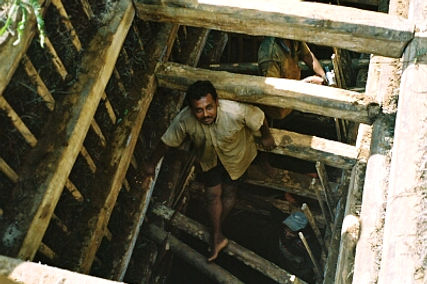

Continuous pumping is done to drain out the water from the pits caused by the natural colluvial ground and (almost daily) rains. The miners' job down the pits is very hard and dangerous. Over the years, many mines collapsed, and thousands of miners died.

Seeing firsthand the mine shaft. These several mine shaft operations were hidden away in the jungle. The high temperature, together with elevated humidity in such a place, is basically unbearable (to me, at least. Next time, I will go bear like them).

Sieving the gem-bearing gravel in a deep rattan basket by the river. This is the final stage of cleaning the illam, which is hauled out in sacks and baskets from the pits. Then blasted with a jet of water from a powerful hose in large wooden boxes. Rocks and cobbles are then hand-picked, and the remaining water is sieved.